

The media takes over the case
Pachacútec's tomb?
The book
The story in video
Contact us
From January 2013, the Inkarri team notices a media surge. But the newspapers distort Thierry Jamin’s statements: his hypothesis that the funeral chamber could be that of Pachacútec becomes an affirmation for them.
In Peru, a media wave hits Inkarri
On January 19, 2013, the Peruvian newspaper El Comercio headlined its front page with "Indagan si en tumba de Machu Picchu hay oro", that is to say "They are looking for gold in a tomb of Machu Picchu". The daily then explains on the front page that "the discovery of gold and silver objects in a funerary chamber of Machu Picchu opposes a group of explorers to the Ministry of Culture who refuse to grant them a permit to continue their research". Then the daily, in its page A16, explains on four columns the discoveries made in April 2012 by Thierry Jamin’s team and the "conflict" that now opposes them to the officials of the Ministry of Culture. The tone is deliberately sensationalist. Journalists insist on the "presence of large quantities of gold and silver".
On 7 February 2013, the Peruvian news website Rumbos published a large article on the discoveries made a few months earlier by the Inkarri – Cusco team. This detailed and objective article sets the powder on fire.
This time the national media are taking up the topic again. Many local and national radio stations, such as RPP, television channels, like ATV, and numerous newspapers seized the affair.
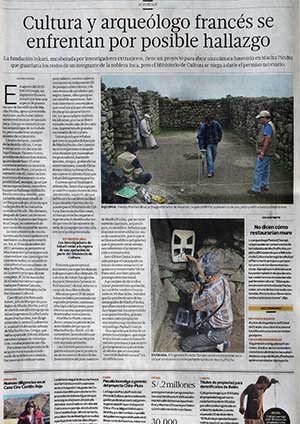
El Comercio
January 19, 2013
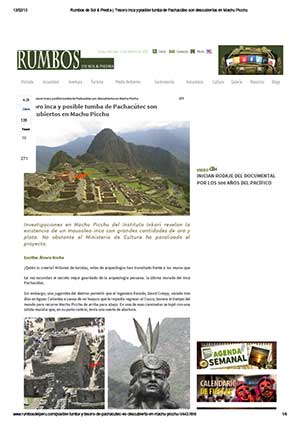
Rumbos
February 7, 2013
When Thierry Jamin's hypotheses become certainties: some media outlets claim that he has found Pachacuti's tomb!
On February 8, 2013, the newspaper El Diario del Cusco ran the headline on its front page "Afirman que hallaron tumba de Pachacutek en Machu Picchu. Hipótesis de franceses fue cuestionada por autoridades peruanas", that's to say "They claim to have discovered Pachacuti's tomb at Machu Picchu. The French hypothesis has been questioned by Peruvian authorities." The Cusco newspaper detailed the discovery of the underground cavities uncovered by Thierry Jamin's team in April 2012. However, it presented the hypothesis of Pachacuti's tomb as a certainty. And of course, it didn't forget to mention the presence of gold and silver deposits: "Frenchman Thierry Jamin claims to have discovered an Inca mausoleum containing large quantities of gold and silver, as well as more than a dozen sarcophagi." These are comments taken the day before from Thierry Jamin, but largely distorted.
In the same issue, local authorities from the Ministry of Culture (Direction Régionale de Culture de Cusco) assert that "it is impossible to discover hidden treasure in the Inca citadel". And Peruvian archaeologist Luis Lumbreras " puso en duda el anuncio del francés, y asegura que el lugar fue saqueado durante la Colonia y señala que Jamin no es un personaje conocido " i.e. "He disputes the Frenchman's claims that the site was looted during the colonial period and points out that Jamin was not a well-known figure
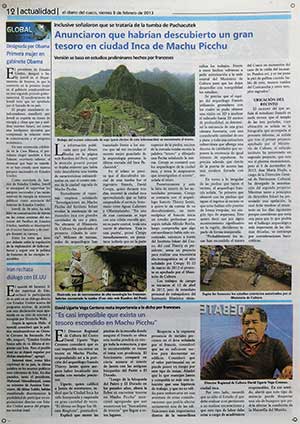
El Diario del Cusco
February 8, 2013
The newspaper then devotes the whole of page 12 to the "Machu Picchu affair". In an article by anthropologist David Ugarte Vega Centeno, Regional Director of Culture for the Department of Cusco, he declares that "it is almost impossible for there to be hidden treasure at Machu Picchu". The focus then seems to be on the presence of gold and silver.
In the same article, Ugarte describes Thierry Jamin as an adventurer and points out that the Inca city of Machu Picchu has been ransacked many times. The latest," he says, "was Hiram Bingham". David Ugarte asserts - though without ever providing any technical evidence - that moving the stones of the building where the famous entrance is located would jeopardize the entire structure.
The former Cusco regional director of culture then quips about Thierry Jamin: " Luego de la búsqueda del Paititi y El Dorado en los pasados años, ahora la fiebre es encontrar tesoros en Machu Picchu ", i.e. "After the quest for Paititi and El Dorado in recent years, now he has the fever to find treasures at Machu Picchu."
On the same day, in the Perú 21 newspaper, David Ugarte further dramatizes and declares that information about the discovery of cavities in the basement of the Temple of the Three Gates should be handled with great caution, " porque podríamos originar un saqueo o el desprendimiento de alguna infrastructura de nuestro principal ícono turístico ", "because we could provoke looting or damage certain infrastructures of our main tourist emblem."
For its part, the Correo newspaper of February 8 devoted an article on page 3 to the Machu Picchu affair. Once again, officials from the Regional Department of Culture - Cusco do their utmost to discredit the discovery. The article is headlined: " Francés asegura que se trataría de contexto fúnerario de Pachacuteq. DRC desvirtúa hallazgo de tumba real ", "The Frenchman claims that it is the funerary context of Pachacútec. The Regional Directorate of Culture refutes the discovery of a royal tomb."
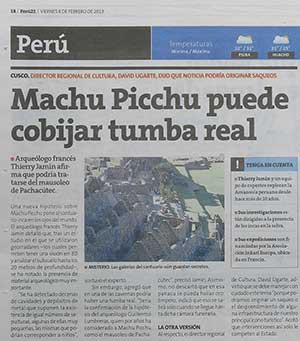
Perú 21
January 19, 2013
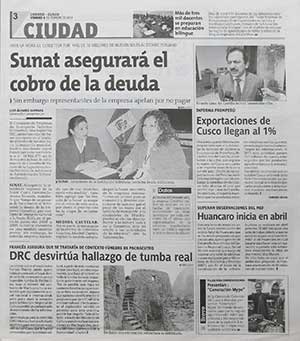
Correo
February 8, 2013
See also on page 10 of the daily Trome, February 8, 2013, the article entitled "At Machu Picchu, they may have found Pachacútec's tomb."
Throughout this period of intense controversy, the attitude of Peruvian archaeologist Luis Guillermo Lumbreras was more than a little puzzling. Indeed, this Lima-based archaeologist spent a large part of his life searching for proof that Machu Picchu was indeed the Llactapata of the Incas, as described in the Suma y Narración de los Incas by the chronicler Juan de Betanzos. And it was in this Llactapata, according to Betanzos (Chapter XXX) that Emperor Pachacútec ordered his tomb to be built, for himself and his descendants. This was also the main hypothesis of Lumbreras.
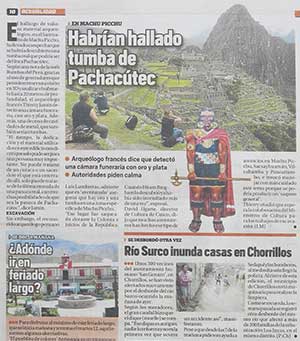
Trome
February 8, 2013
Denial: Luis Lumbreras is suddenly no longer sure that Machu Picchu contains the tomb of Pachacútec...
In 2005, Luis Guillermo Lumbreras contributed to the collective book Machupicchu. Historia, Sacralidad e identidad. In a very long article entitled "Machu Picchu, el mausoleo del emperador" (pp. 14 - 38), he writes, for example: "There is no doubt that a sanctuary of the highest rank was located here. If 16th-century documents are to be believed, all the numerous agricultural installations were intended to produce goods for the Inca cult of the dead. Machu Picchu is over 100 km from Cusco by train. It may well be Patallaqta ("city on high"), the place where the mummy of the Inca Pachacútec was preserved and venerated."
And yet, Luis Guillermo Lumbreras is about to say the exact opposite of everything he has always maintained throughout his career!
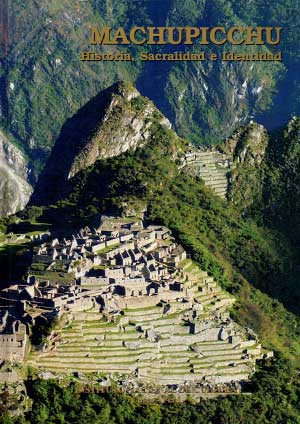
Machupicchu. Historia,
Sacralidad e Identitad
Article by Luis Lumbreras
Local officials from the Ministry of Culture will compete to denigrate the work of Thierry Jamin and his team.