

Some media change their attitude
Underground cavities at Machu Picchu
The book
The story in video
Contact us
The discovery of underground cavities in the basement of the Temple of the Three Doors has led to numerous publications, most of them polemical. Nevertheless, with the pressure falling back, a few more objective articles finally see the light of day.
More neutral articles on the underground cavities discovered under the Temple of the Three Gates...
On 15 February 2013, the newspaper El diario del Cusco published on its front page and on page 9 one of the few complete and truly objective articles devoted to this incredible story. Under the title "Thierry Jamin argues that he is convinced that the study area holds a great cultural treasure." , the journalist then presents on five columns the discoveries made in April 2012 at Machu Picchu and the stakes for the history of Peru that could represent the opening of the entrance identified by David Crespy and the study of the archaeological material contained in the underground cavities.
On the same day, February 15, 2013, the newspaper El Comercio, in its page A24, opens its columns to the Peruvian historian Teodoro Hampe Martínez. The journalist Raúl Mendoza Cápena dedicates him a long interview about the discoveries made by Thierry Jamin’s team at Machu Picchu and the supposed current location of the Inca mummies.
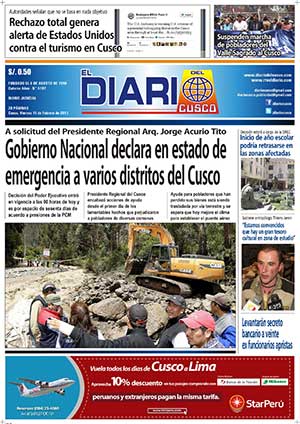
El Diario el Sol del Cusco
February 15, 2013
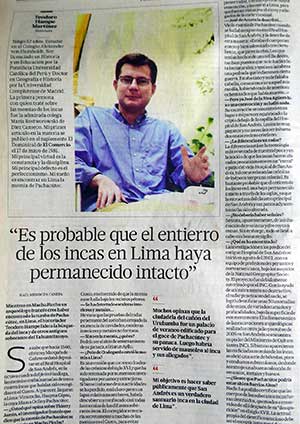
El Comercio
February 15, 2013
The underground cavities of Machu Picchu in a prestigious magazine
For Teodoro Hampe, the underground cavities discovered in the basement of the Temple of the Three Gates by the Inkarri team could correspond to the burials of the panaca, or lineage, of the emperor Pachacútec. But, according to him, the imperial mummy was brought back to Lima in the 16th century by the Spanish conquerors and then hidden with other Inca mummies in a secret crypt located under the foundations of the San Andrés Hospital. The historian of Lima has been actively searching for imperial mummies since the '80s and carried out several electromagnetic resonances at the San Andrés Hospital in the early 2000s in order to locate the famous secret crypt.
Despite the controversies fueled by local authorities, on February 15, 2013, the Spanish edition of the renowned American magazine National Geographic devoted a significant article to the discovery made by the Inkarri group in April 2012 at Machu Picchu, in its online edition. Under the title "¿Esconde algo Machu Picchu? Según el investigador francés Thierry Jamin, el subsuelo de uno de los edificios podría esconder una tumba real", or in English, "Is Machu Picchu hiding something? According to French researcher Thierry Jamin, the subsoil of one of the buildings could conceal a royal tomb," the British journalist Alec Forssmann objectively explains the circumstances of this incredible discovery, its implications, and the emerging controversies it sparked in Peru. On Sunday, February 17, 2013, Hilbert Sumire Bustincio, director of the Machu Picchu 2012 project, and Thierry Jamin, executive director of the same project, participated in the program "Debate", hosted by journalist Washington Alosilla Portillo, on Canal 45 in Cusco. During this widely watched Sunday program, Hilbert and Thierry shared with the journalist their concerns regarding the desire of local officials from the Ministry of Culture and the archaeological sanctuary of Machu Picchu to appropriate the fundamental discoveries made by the Inkarri group in April 2012 at the Inca citadel.
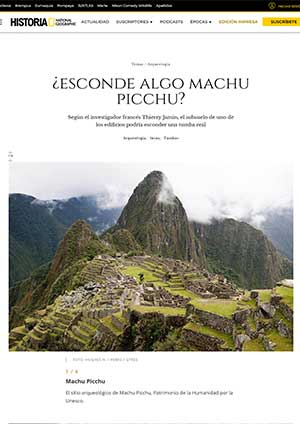
Historia - National Geographic
February 15, 2013
The television interview given to the two researchers will be repeated on two columns the next day, February 18, 2013, on page 2 of the daily newspaper El diario del Cusco. Excerpt:
"French archaeologist Thierry Jamin stated that problems with the professionals and staff of the Regional Directorate of Culture appeared from the beginning of his research at Machu Picchu. From the outset, his team showed suspicion and hostility.
"In this regard, not only was the research conducted under the supervision of the staff of this cultural organization, but their presence was excessive. They took photos of the whole team, recorded videos and made sketches, which even raised doubts about their supervisory role.
"They were constantly with us and I think that in the absence of any professional ethics, at least ten archaeologists were present permanently. The regulation of archaeological excavations provides for only one professional as supervisor."
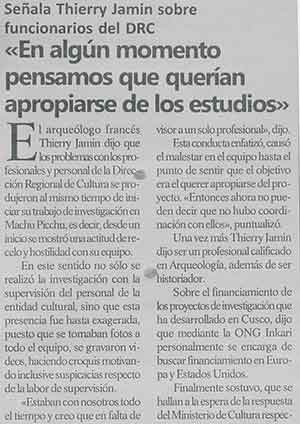
El Diario del Cusco
February 18, 2013
On February 21, 2013, the channel IBTime TV dedicated a report entitled "An archaeologist prevented from making a major discovery at Machu Picchu".
IBTime TV - An archaeologist prevented from making a major discovery at Machu Picchu - 1mn 28
The local authorities of the Ministry of Culture are going to organize a mock press conference in Machu Picchu for the media who have taken up their cause.