

The Inkarri team perseveres
The project to open the door continues
The book
The story in video
Contact us
A new version (V2) of the door opening project was presented to the authorities and rejected once again. And yet, in December 2013, the Inkarri Institute was awarded the “El Inka Dorado Award!” for the best research project of the year by the Peruvian Chamber of Commerce and Development (Ministry of Industry and Tourism)! In July 2014, a third version of the opening project was submitted to the authorities. It took into account the comments made previously. And it was rejected once again!
A new project to open the door
Despite the controversies and maneuvers of all kinds to prevent Thierry Jamin and his group from continuing their project to open the burial chambers discovered under the Temple of the Three Doors in April 2012, the team from the Inkarri Institute – Cusco is once again presenting their opening project to the Ministry of Culture on June 13, 2013. Still led by Cusco archaeologist Hilbert Sumire Bustincio, the project is registered under reference number 023078 – 2013.
During July and August 2013, the project entitled Proyecto de Investigación Arqueológica (Con Excavación). Apertura de Vano de Acceso Tapiado del recinto 02, del Sector II, Sub Sector E, Unidad 03, del Sector Urbano de la Ciudadela Inka de Machu Picchu, is once again being evaluated by the relevant authorities.
At the end of August, the project was declared inadmissible due to the ongoing appeal of the November 5, 2012 decision filed by Thierry Jamin and Daniel Merino in December 2012. But the case is stalling. Despite the legal deadlines, the courts are not moving forward. Local officials from the Ministry of Culture are clearly trying to buy time and let the situation fester.
Thierry Jamin sends a complete copy of the Machu Picchu Project to Gérard Borras, Director of the French Institute of Andean Studies, for a technical review of the planned research. Mr. Borras promises to submit the project to his specialists. The French explorer will not be disappointed!
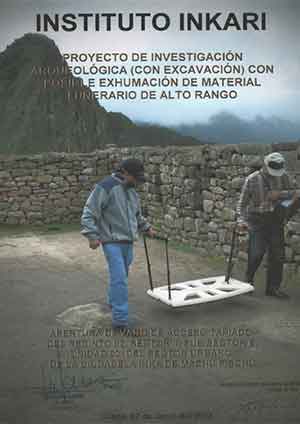
V2 door opening project
June 13, 2013
In September 2013, a team of archaeologists from the Machu Picchu National Historical Sanctuary carried out various measurements and several scans of the Temple of the Three Doors and the entrance. French tourists who were present that day observed the scene and took photos. There are rumors of a project presented by Machu Picchu park officials to open the underground chambers. This project competes with that of the Inkarri Institute.
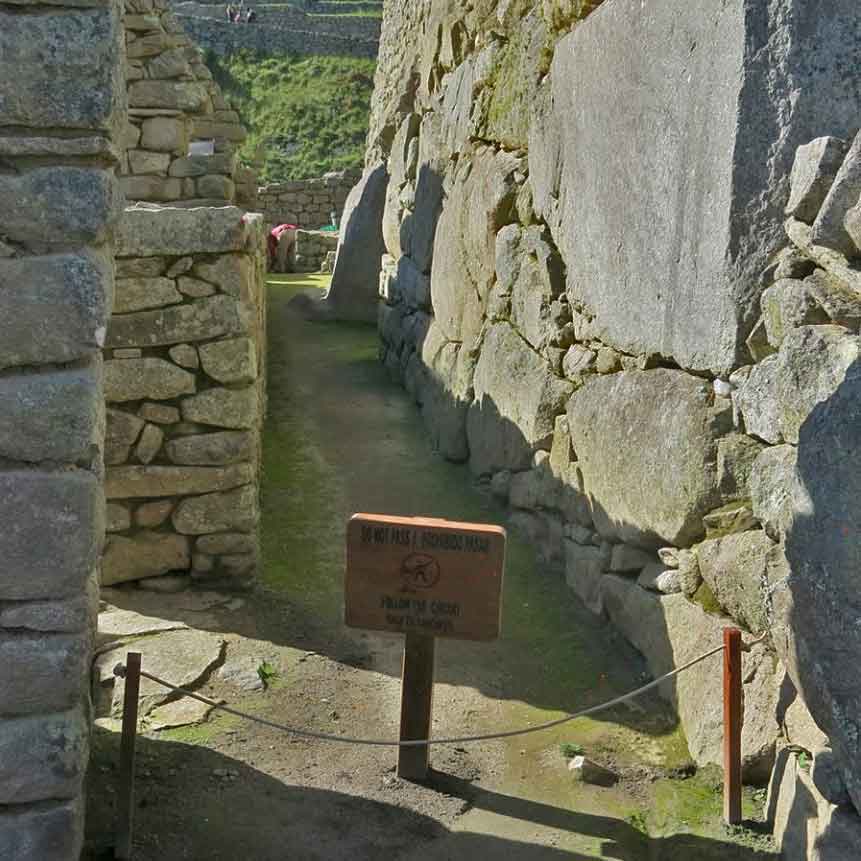
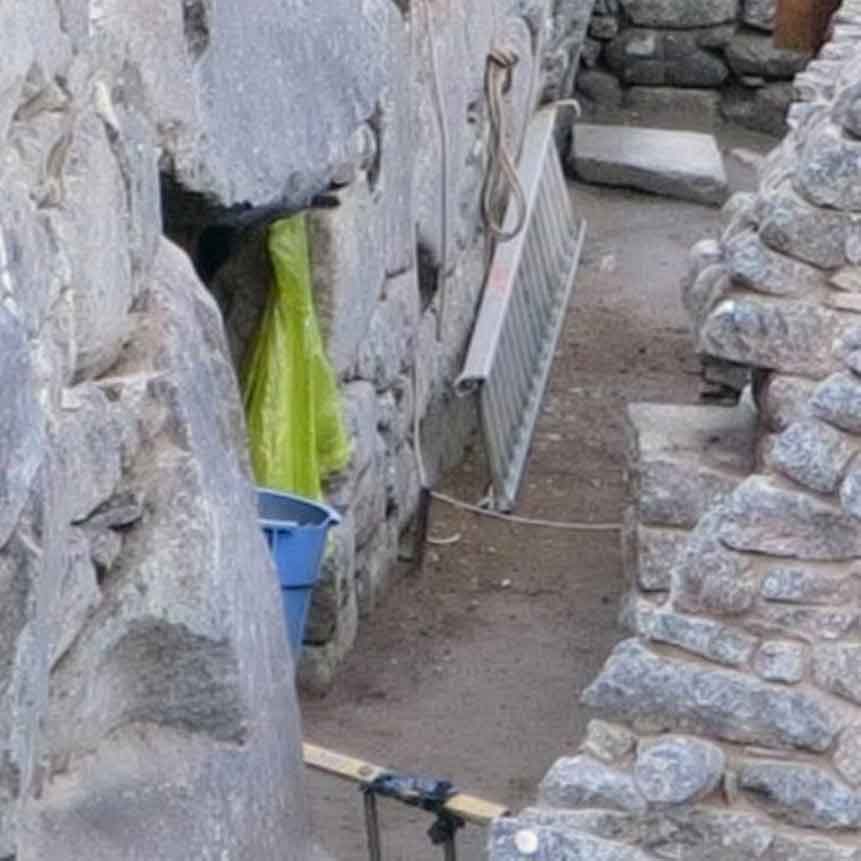
Since the controversy, access to the entrance leading to the caves discovered by Thierry Jamin and his team in April 2012 has been prohibited. A sign reads Prohibido pasar (No entry) and it is impossible to approach the site...
IFEA's puzzling opinion on opening the gate at Machu Picchu
On October 3, 2013, Gérard Borras, Director of IFEA (French Institute of Andean Studies), sent Thierry Jamin a two-page document serving as a “technical evaluation” of the Machu Picchu project. On the first page, Mr. Borras states that "we have agreed to have your project evaluated by our expert archaeologists. You will find their comments in the attached document. Their analyses, conducted with the utmost objectivity and professionalism, seriously invalidate the case. We are therefore unable to provide any scientific or logistical support for your project." The document in question is only one page long!
It's a real shock! Far from being a “rigorous and professional technical assessment” (sic), the document clearly shows that no serious study has been conducted on the project in question. The inaccuracies and technical errors made by the so-called “experts” prove that no IFEA specialist has actually looked into the matter.
It seems that these “experts” based their conclusions solely on the Machu Picchu 2012 project presentation brochure intended for the media and project partners.
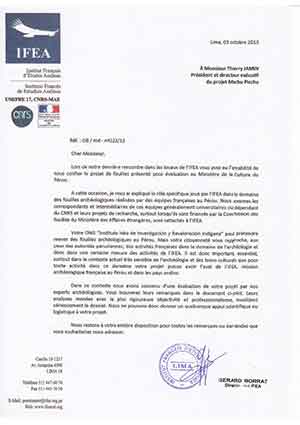
Response from IFEA
October 3, 2013
On November 27, 2013, Thierry Jamin sent a long letter to Mr. Borras in which he responded point by point to the “technical evaluation” carried out by the IFEA “experts.”
Everyone can form their own opinion in good conscience...
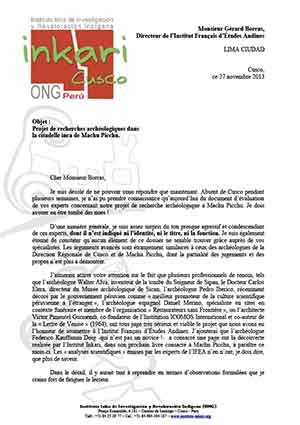
Thierry Jamin's response to the IFEA
November 7, 2013
Some even question the geo-radar diagnosis. On November 5, 2013, David Crespy contacted OKM, the manufacturer of the Rover C New Edition and Cave Finder. Were the data obtained by our team reliable? OKM confirmed to David Crespy the results of the resonances carried out by the Inkarri team. The discoveries are real. The company is so convinced of this that it will even use these discoveries on its website to promote the Rover C New Edition and the CaveFinder...
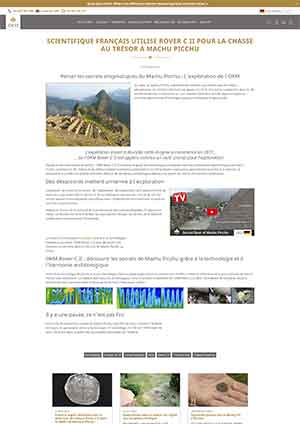
OKM company website
In December 2013, the Peruvian Chamber of Commerce and Development (DIRCETUR) awarded the Inkarri Institute – Cusco the “El Inka Dorado Award” for the best scientific research project for the Machu Picchu 2013 Project.
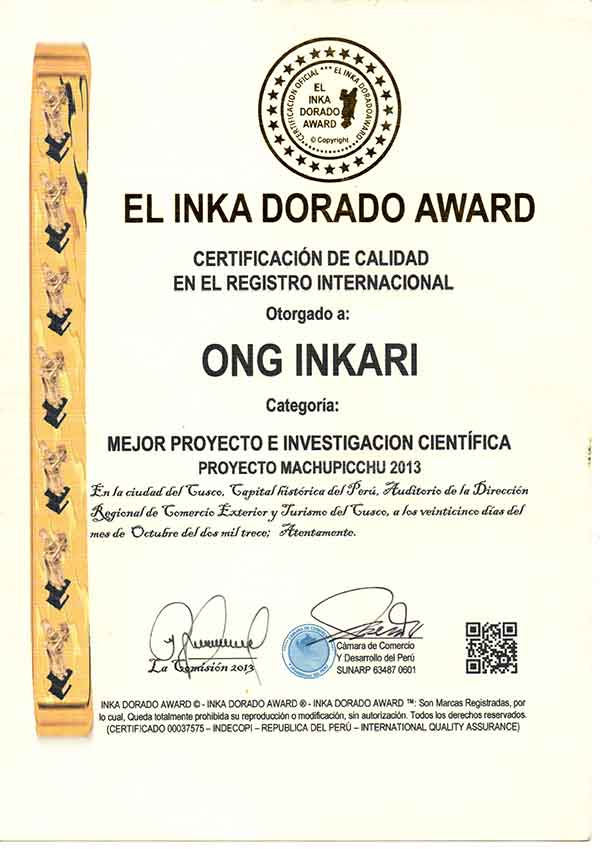
El Inka Dorado award
December 2013
On January 7, 2014, Gérard Borras, director of IFEA, responded to Thierry Jamin's letter dated November 27, 2013. Without addressing Thierry's technical observations, the director's response was extremely polite and diplomatic. The Machu Picchu affair had become political. Peru was free to work with whomever it wanted...
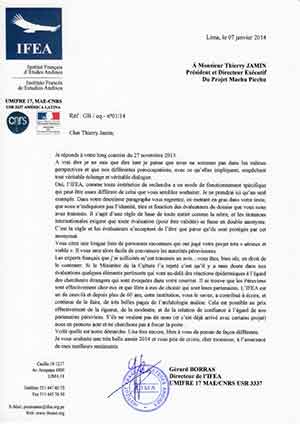
Response from IFEA
January 7, 2014
On January 10, 2014, Thierry Jamin submitted an official letter to the Ministry of Culture stating that his team was abandoning its appeal against the decision of November 5, 2012. The letter was registered by the ministry on January 29, 2014, under reference number 023078-2013.
On April 14, 2014, the Ministry of Culture, through its Directorial Resolution No. 177 – 2014 – DGPA – VMPCIC / MC, validated the withdrawal of appeals for annulment of the Directorial Resolution of November 5, 2012.
A new project to open the door
On July 14, 2014, the Inkarri Institute – Cusco once again officially presented a research project led by Peruvian archaeologist Hilbert Sumire Bustincio, whose objective remains to open the underground cavities discovered in April 2012 and study the archaeological material contained in the possible burial chambers. The project is registered under reference number 029622 – 2014.
The project has grown. The international organization Restaurateurs Sans Frontière is ready to participate in the excavations. And American anthropologist Haagen Dietrich Klaus, from George Mason University in Virginia (USA), is joining the group as a specialist in the study of organic funerary material.
During July and August 2014, the Machu Picchu project led by the Inkarri – Cusco team was once again reviewed by various departments of the Ministry of Culture. A few weeks ago, a Technical Commission was re-established in Cusco. It is therefore up to the Regional Directorate of Culture in Cusco to decide whether or not to grant Thierry Jamin's team a research permit. Of course, the project must also be subject to a technical opinion from the officials of the Machu Picchu National Historical Sanctuary...
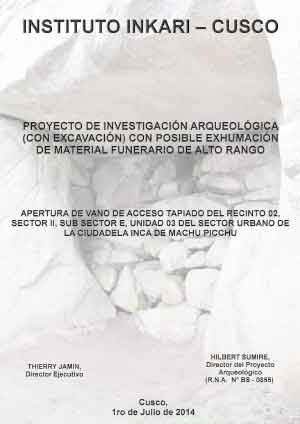
Machu Picchu Project v3
July 14, 2014
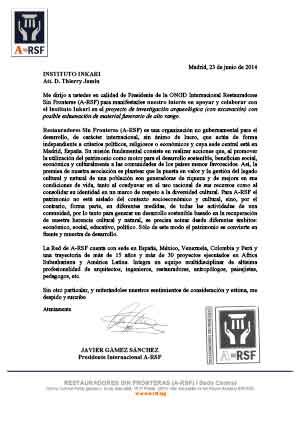
Restaurateurs Without Borders
June 26, 2014
On September 4, 2014, the Regional Directorate of Culture of Cusco sent a letter to the Inkarri Institute, under reference No. 1306 – 2014 – UACGD – DDC – CUS / MC. The letter was accompanied by Resolución Directoral No. 634 – DDC – CUS / MC, dated September 2, 2014, in which the Inkarri Institute – Cusco's request for authorization to open the underground cavities discovered in April 2012 was once again rejected.
This time, the reason given is as follows: the Inkarri project has been declared inadmissible due to the existence of a “competing project” led by archaeologist José Miguel Bastante Abuhadba and naturally supported by the National Historic Sanctuary of Machu Picchu. Entitled “Programa de Investigaciones Arqueológicas e Interdisciplinarias en el Santuario Histórico de Machupicchu – PIAISHM” (Archaeological and Interdisciplinary Research Program at the Historic Sanctuary of Machu Picchu), it has reportedly been approved for a period of three years and provides for research, including excavations, in fifteen areas of Machu Picchu. It is easy to imagine that among the areas selected is—as if by chance!—the famous Temple of the Three Doors...
Two years after the discovery, there has been no progress on opening the entrance blocked by the Incas beneath the Temple of the Three Doors. We have learned that a competing project has been submitted...