

A sham press conference
The opening of the door
The book
The story in video
Contact us
On Thursday, February 21, 2013, local officials from the Ministry of Culture and the National Historical Sanctuary of Machu Picchu held a press conference at the Inca citadel. Journalists from Cusco, Lima, and various foreign countries were invited to attend. These officials then launched a major information manipulation campaign regarding the proposed opening of the gate, and their statements were widely reported the following day in the local and national press.
The subservient media are flocking to the conference where the opening of the door is being discussed...
In its February 22, 2013 edition, the newspaper El Diario el Sol del Cusco, still hostile to Thierry Jamin and his group, ran the headline on its front page: “The door will remain closed. The Cusco Directorate of Culture rejects the request from the NGO Inkari to conduct excavations at Machu Picchu.” The newspaper devoted its entire third page to “the case of the opening of the door”… and it’s quite something! A textbook case of information manipulation, courtesy of Fernando Astete, director of the National Historic Sanctuary of Machu Picchu! Judge for yourself:
The newspaper El Diario el Sol del Cusco devotes a "special page" to the Machu Picchu affair, accompanied by an almost defamatory headline: "The Directorate of Culture rejects the treasure hunters' request. Excavations at Machu Picchu would endanger the Inca walls and enclosures of this wonder of the world."... The rest is no less dramatic!
The article begins by stating that the then Regional Director of Culture, David Ugarte Vega Centeno, had just announced that the permit application submitted by the Inkarri-Cusco Institute to open the gate would not be approved by the regional authorities because the project would seriously endanger the mythical Inca city, now considered a Wonder of the World and a World Heritage Site. This statement was made to journalists during an "organized visit" intended to explain to the world's media the "claims" (sic) of the NGO Inkarri-Cusco.
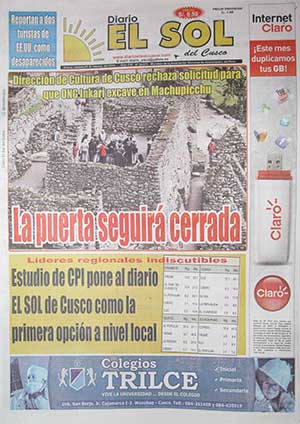
El Diario el Sol del Cusco
February 22, 2013
During the visit, the "specialists" from the Regional Directorate of Culture – Cusco, warned that "allowing the excavations to take place at Machu Picchu, as requested by the NGO Inkarri Cusco and the French citizen Thierry Jamin, to discover the supposed tomb of Pachakuteq, would seriously jeopardize the stability of the walls and finely crafted buildings that form the architectural ensemble of the wonder of the world."
Machu Picchu conservation officials, led by park director Fernando Astete Victoria, "revealed that the aforementioned treasure hunters claim to be moving over 600 square meters of land."
The proposal to open the gate submitted by Inkarri was clearly not read by the authorities
This claim, accompanied by defamatory remarks (“treasure hunters”), is completely false. As internet users can see for themselves by consulting the project in question, Thierry Jamin’s team is only talking about removing 2 to 5 cubic meters of small stones: the rubble deposited at the entrance discovered by David Crespy in 2010 to block access to the stairs leading to the underground chambers. And nothing more!
Fernando Astete Victoria, who made these false statements, adds that "it would be a real barbarity that would affect several buildings, passages, walls and terraces which would end up coming loose, and we are not going to allow that."
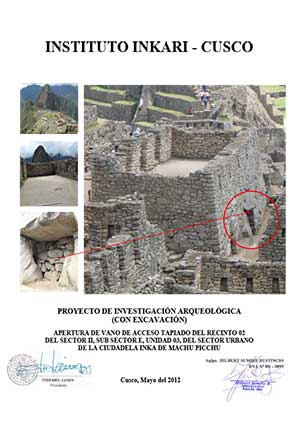
Door opening project
March 2012
Experts confirm that opening the door would in no way endanger the building
Faced with the absurdity of the statements made by the self-proclaimed "specialists" in civil engineering, the Inkarri Institute sought the opinion of two experts regarding the opening of the gate. Their conclusions differ significantly from the assertions made by the Regional Director of Culture, David Ugarte Vega Centeno, and by Fernando Astete Victoria, director of Machu Picchu National Park.
Testimony of the architect and conservator Victor Pimentel regarding the opening of the door giving access to the underground chamber beneath the Temple of the Three Gates
Victor Pimentel is a Peruvian architect and restorer of built heritage. He is known for his commitment to the preservation of archaeological and historical sites in Latin America. His nickname, "guerrilla," was given to him because of his fight to safeguard culture and monuments. He signed the Venice Charter on behalf of Peru in 1964, an international treaty for the preservation and restoration of ancient objects and buildings.
In this document, he says:
“The stones obstructing access to the potential enclosure under study are not structural elements supporting the building in this area, nor the wall, but simply a dry-stone wall closing the opening. Therefore, the partial demolition of this wall will not cause any structural or architectural damage in the area under study.”
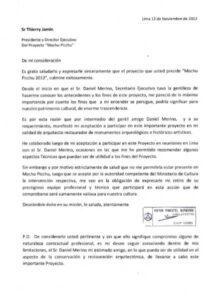
Victor Pimentel's opinion
Technical report by César del Carpio Contreras, civil engineer:
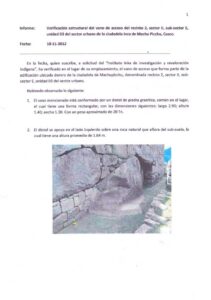
“The wall of the structure known as Enclosure 2, Sector 11, Sub-sector E, Unit 03 of the urban sector of the Machu Picchu citadel, where the opening that is the subject of this report is located, currently presents no structural instability issues. This opening is a walled entrance providing access to a passage located behind it.
“The stones blocking the opening, stacked without mortar, can be removed without affecting the structural stability of the wall. However, support elements can be used to reinforce the lintel, such as wooden or metal props, or other bracing structures designed to support the weight of the 20-ton stone used as the lintel.
“The weight of the soil at the top of the enclosure rests on the natural bedrock outcrops. By ensuring the stability of the lintel of the opening, there is no possibility of altering the structural balance of the enclosure above.”
Cesar del Carpio's opinion
During the explanations given by the Machu Picchu "experts," archaeologist Piedad Champi, responsible for the upkeep of the Inca citadel, pointed out that archaeological research had already been conducted on the site three years prior: "By excavating the original ground level, we discovered fragments of ceramic and metal, and it was confirmed that the ground is composed of rocks and stones, an architectural style used in this location. Machu Picchu was built on a granite chaos, that is, on a promontory of irregularly accumulated rocks." She asserted that empty spaces appear between these rocks, which could be mistaken for passageways or underground chambers.
The opening of the gate, probably blocked by the Incas, is met with the closed-mindedness of the local authorities.
The general public and archaeological research specialists alike will appreciate this incredible disinformation campaign and manipulation of information. A complete lack of intellectual honesty and professional ethics!
This “Machu Picchu affair” is totally summarized in this rigged press conference, organized in the Inca citadel on Thursday, February 21, 2013 to discredit Thierry Jamin’s team and their research project.
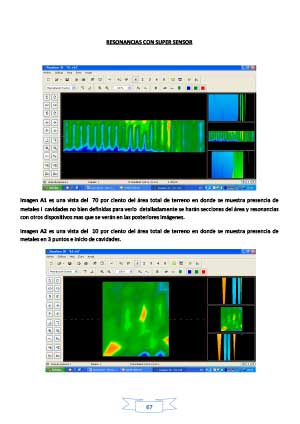
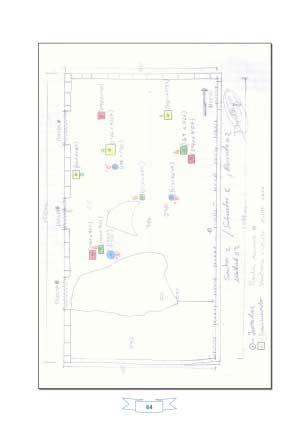
But what the ground-penetrating radar shows is quite different! (Ground-penetrating radar diagnosis: part 1 – part 2). The located cavities are regular. The main chamber, square in shape, measures three meters on each side and is oriented north-south. Archaeological material is generally associated with these elongated, human-sized cavities. Therefore, they cannot be "empty spaces," as Ms. Piedad Champi claims. The entire structure corresponds to a classic funerary pattern from the pre-Hispanic period. The "specialist" officials in charge of the Machu Picchu sanctuary cannot be unaware of this…
Geo-radar diagnostics
Part 1
Geo-radar diagnostics
Part 2
Fernando Astete Victoria then claims that the technical project presented by "the French citizen" included a simple plan of the building without any sketches or other details explaining the technical and scientific way of making the door opening... which, naturally, is entirely false, as professionals in the field will be able to see by consulting the project.
Fernando Astete Victoria, in his desire to portray Thierry Jamin's team as a group of amateurs and mere "treasure hunters", adds that "scientific work cannot be carried out in an improvised manner with the sole aim of discovering fabulous treasures as these citizens dream of".
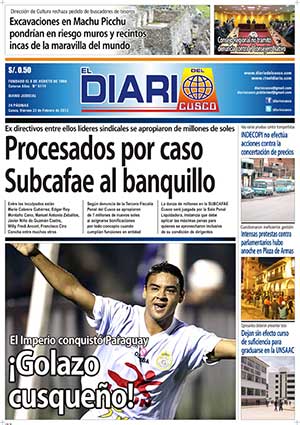
On February 22, 2013, the newspaper El Diario del Cusco ran the headline "Excavations at Machu Picchu Could Endanger the Inca Walls and Enclosures of This Wonder of the World." The Cusco daily then devoted page 2 to the previous day's "guided tour" organized by officials from the Regional Directorate of Culture – Cusco and the National Historic Sanctuary of Machu Picchu. The content of this article naturally consisted of the false information presented the day before by these so-called "experts" on the Inca citadel.
El Diario del Cusco
A few days later, in its Sunday edition of February 24, 2013, the newspaper El Diario el Sol del Cusco again devoted a special edition, on page 8, entitled "The Quest for 'Inca Treasure' at Machu Picchu: Between Cinematic Fiction and Scientific Reality. In the past, tomb looting was a common practice." In this article, its author, Bertha Bermúdez Zamalloa, draws a parallel across four columns between the huaqueros, or looters of archaeological treasures, and the research of Thierry Jamin. And as if to emphasize this point, the newspaper published a photo of the American actor Charlton Heston, wearing a hat and leather jacket, from the famous film "The Secret of the Incas" (1954) in which he plays the role of a corrupt archaeologist and treasure hunter. To the right, next to this photo, as if to establish a parallel, the newspaper shows a photo of Thierry Jamin wearing a similar leather jacket and felt hat.
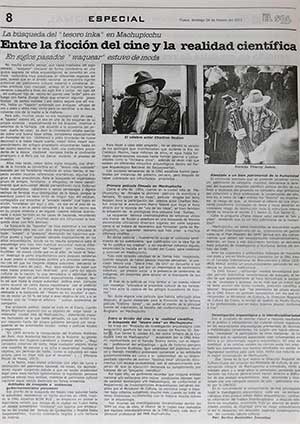
El Sol del Cusco
On February 25, 2013, the local television station RTV broadcast a 37-minute program dedicated to the search for Thierry Jamin and his team at Machu Picchu.
A few days later, Thierry Jamin received an anonymous letter at his home.