

The facts
Beneath the Temple of the Three Doors
The book
The story in video
Contact us
After submitting his Final Research Report to the Peruvian Ministry of Culture (approved on September 5, 2012, by a new Directorial Resolution), Thierry Jamin is now preparing for the next stage: the opening of the entrance beneath the Temple of the Three Doors, blocked by the Incas more than five centuries ago.
The project to open the entrance under the Temple of the Three Gates
On May 22, 2012, Thierry Jamin officially submitted a request to the Peruvian authorities for authorization allowing his team to open the door. This new research project was then called Proyecto de Investigación Arqueológica (con excavación), con Posible Exhumación de Material Funerario de Alto Rango. Apertura de vano de acceso tapiado del Recinto 02, Sector II, Sub Sector E, Unidad 03, del Sector Urbano de la ciudadela inka de Machu Picchu. The reward would be the discovery of what was likely to be an extraordinary archaeological treasure and new insights into the forgotten history of the Incas.
Led by Thierry Jamin (Executive Director) and Hilbert Sumire (Archaeological Project Director), Operation Machu Picchu 2012 benefited from internationally recognized professional expertise, such as that of Peruvian architect and conservator Victor Pimentel Gurmendi, Conservation Director for the project. In 1964, Mr. Pimentel participated on behalf of the Peruvian government in the drafting of the Venice Charter, the global reference document for the protection and conservation of historic monuments.
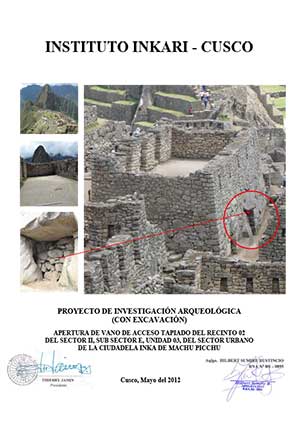
Door opening project
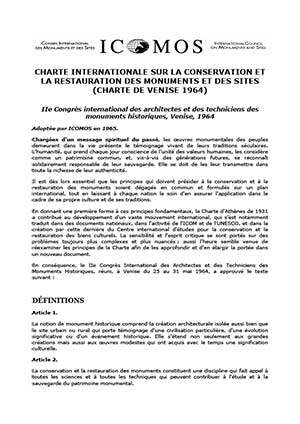
The Venice Charter signed by Victor Pimentel
Given the significant excitement generated throughout Peru by these fabulous discoveries beneath the Temple of the Three Doors and the heated controversy sparked by local officials from the Ministry of Culture (Directorate of the National Historical Sanctuary of Machu Picchu and Regional Directorate of Culture – Cusco), Internet users will find below the facts as they unfolded between 2012 and 2014. All information is verifiable.
Against all odds, the most difficult times are just beginning...
Between June and October 2012, the Machu Picchu 2012 project underwent various assessments by the relevant departments of the Ministry of Culture in Lima. During these assessments, the project was finally forwarded to the management of the Machu Picchu National Historical Sanctuary for an opinion on its viability.
On July 19, 2012, in her report No. 189 – 2012 – DPANM – DRC – CUS / MC, archaeologist Piedad Champi Monterroso wrote an extremely negative report on the famous project: the entrance discovered by David Crespy was nothing more than a retaining wall; the Inkarri Institute – Cusco was a “foreign organization”; archaeologist Hilbert Sumire was merely a “tourist guide”; and Thierry Jamin's team was a group of “treasure hunters,” etc.
So much for the “scientific” evaluation of the project...
For his part, anthropologist Fernando Astete Victoria, director of the Machu Picchu Sanctuary, sent a letter to anthropologist David Ugarte Vega Centeno, Regional Director of Culture for the department of Cusco, in which he stated that the team from the Inkarri Institute – Cusco had never coordinated with him to carry out this research. However, he was present during the electromagnetic surveys carried out on the site in April 2012 and appeared very satisfied with the results of the ground-penetrating radar, as shown in the photographs below:
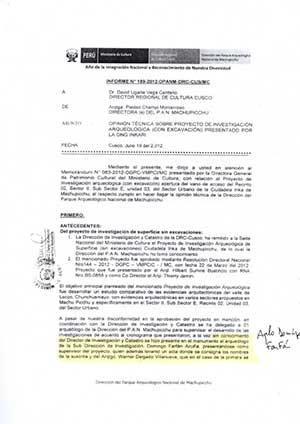
Piedad Champi's “report”
July 19, 2012
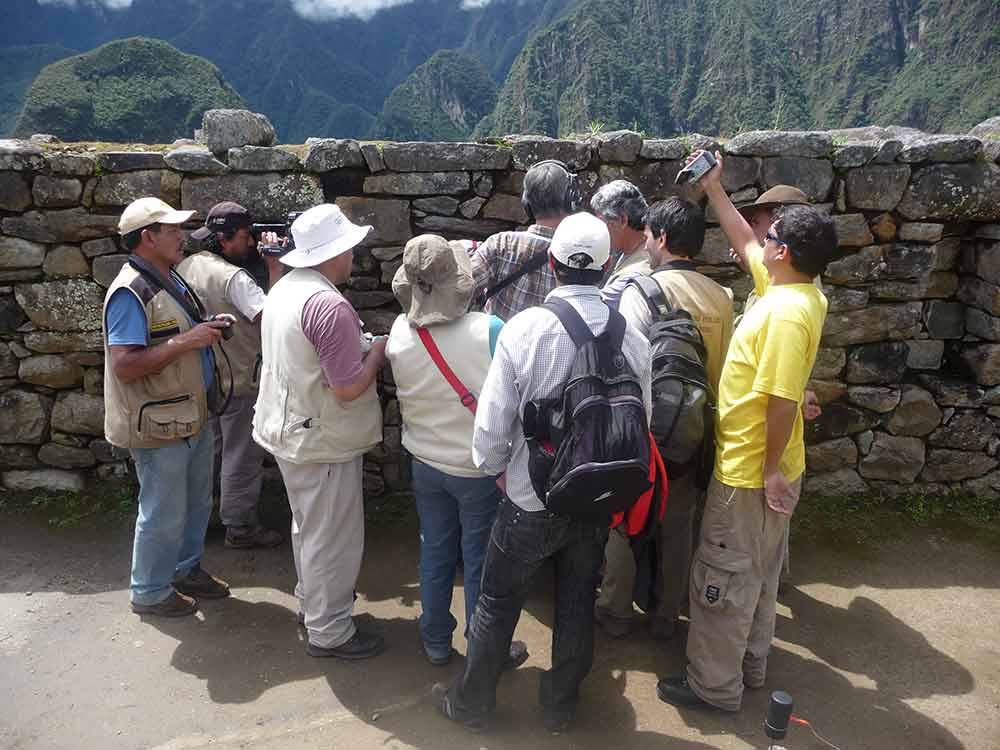
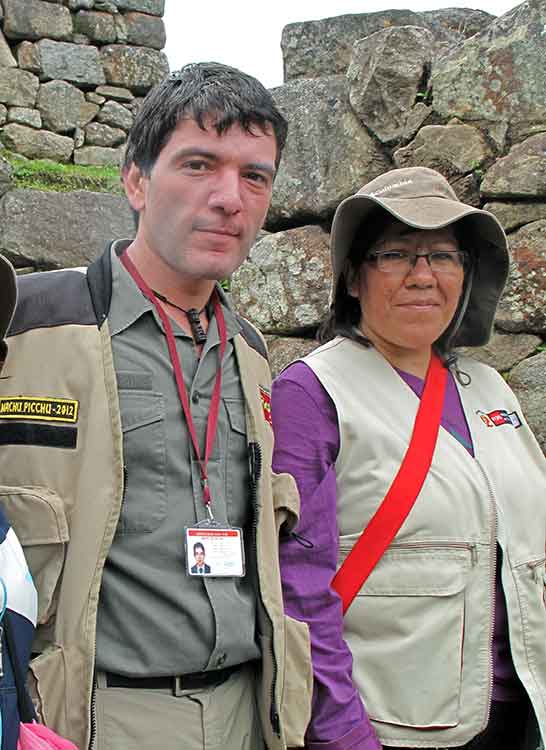
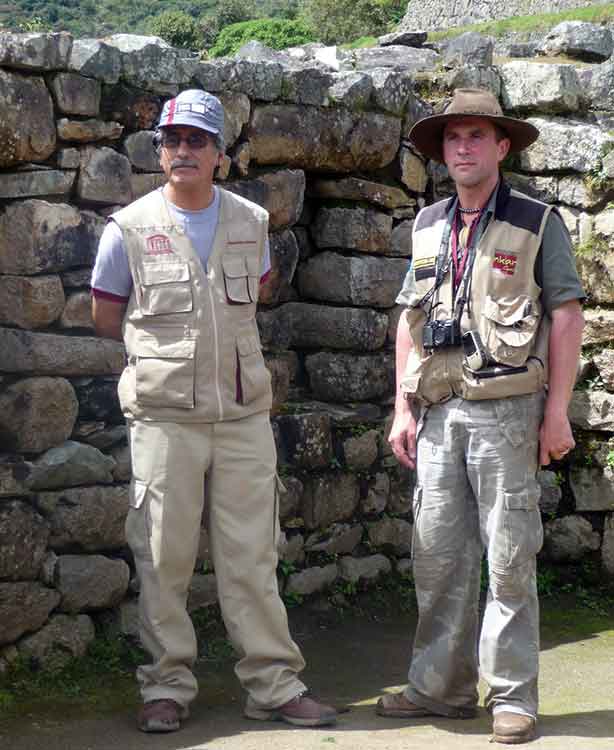
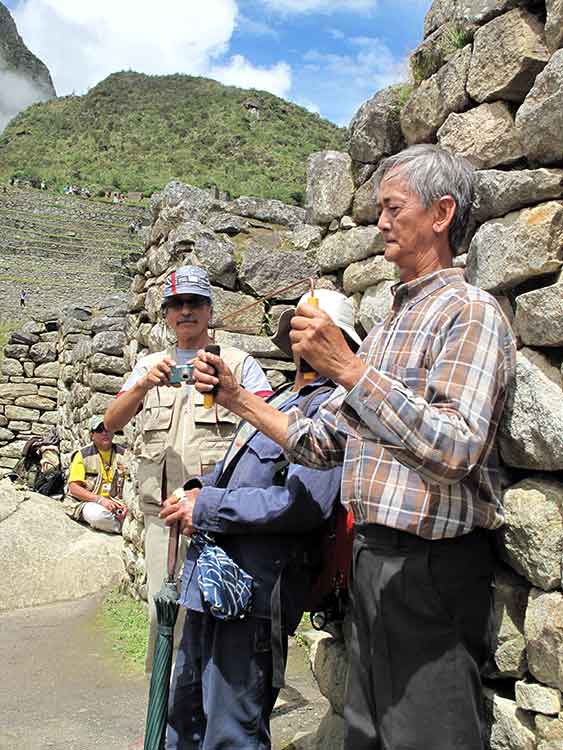
In the same letter, Mr. Astete states that “the site in question (the wall that had been blocked up) was dismantled and then rebuilt several years earlier, although he was unable to specify when.” However, to date, the anthropologist has not provided any material evidence, photographic documentation, or reports to support this claim.
The opening of the entrance under the Temple of the Three Doors is denied
Based on this “scientific evidence,” officials from the Ministry of Culture sent Thierry Jamin and Hilbert Sumire their final response a few weeks later: on November 5, 2012, through its Directorial Resolution No. 826 – 2012 – DGPC – VMPCIC / MC, the research permit was denied to the Inkarri Institute team.
On December 4, 2012, Thierry Jamin and Daniel Merino officially submitted an appeal to the Ministry of Culture, requesting that the Peruvian authorities reconsider their decision and re-examine their research project on the basis of more objective technical criteria.
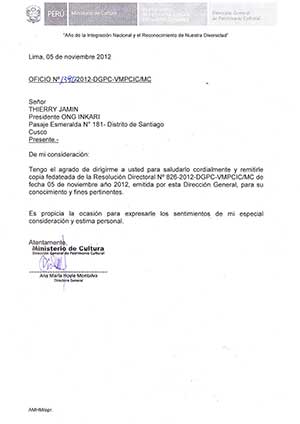
Directorial Resolution of the Ministry of Culture
November 5, 2012
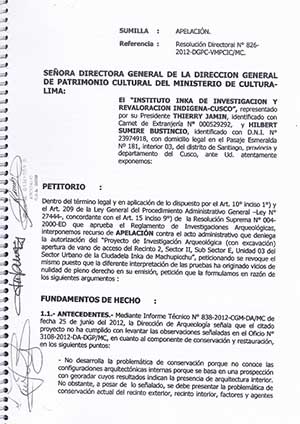
Appeal filed by the Inkarri Cusco Institute
December 4, 2012
Then, in early 2013, the media picked up on the story.